How to Secure a Business Website: A Complete Guide.
Gangatara Team
Engineering & Design Experts
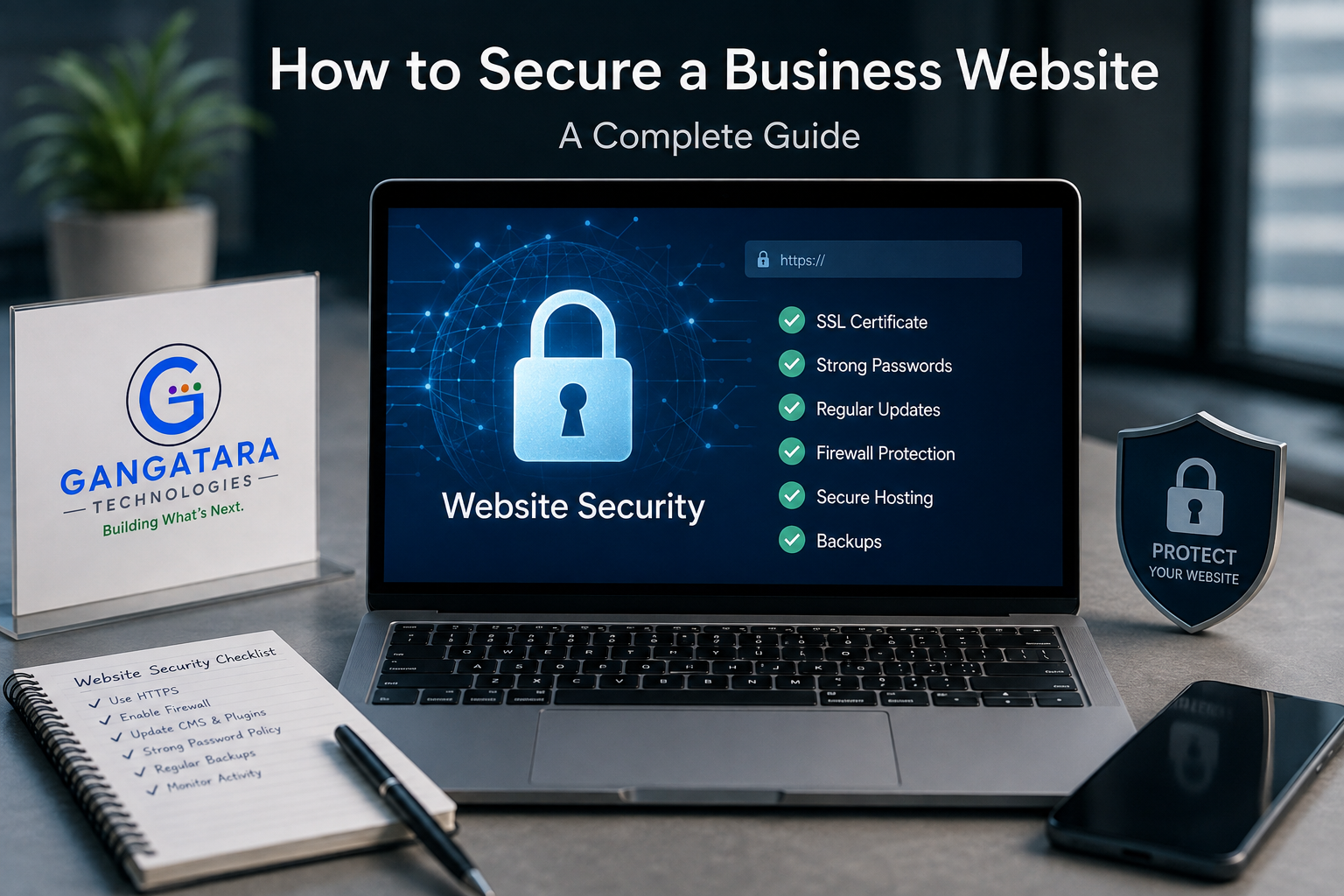
A business website serves numerous functions, including storing customer information, contact forms, business data, payments, messaging, and other essential information. The threat landscape poses a significant risk; therefore, it is necessary for companies to consider taking extra measures to secure their websites.
Website security checklist
is required to guarantee the safety of the business and its clients and build the organization’s reputation. There are various software and recommendations that firms should consider to ensure their sites are safe and secure. The following are ten best practices for securing a website.
1. Use HTTPS & Install an SSL/TLS Certificate.
HTTPS, or HyperText Transfer Protocol Secure, is a communication standard used to secure traffic between browsers and websites. It encrypts the data transmitted on the site to ensure that the information is safe and secure from hackers and other malicious users. All organizations must ensure that their websites and domains use HTTPS and an SSL/TLS certificate to guarantee the confidentiality and encryption of data transmitted on the website. Moreover, it is essential for users to deal with sites that have the “HTTPS” tag.
2. Update Content Management Systems, Plugins, Themes, Frameworks, etc.: Frequently
Companies and website administrators need to update their plugins, themes, framework CMS, libraries, or systems. Frequently, these updates come with enhanced security features and improvements to address existing loopholes in the site structure. It is essential for administrators to always work with the latest versions of their plugins and systems to ensure they are not vulnerable to cyber-attacks.
3. Strong Authentication.
Weak or even no passwords can jeopardize an organization’s data and information security. Firms can strengthen authentication features and enhance security in various ways. Some of the most effective strong authentication methods include:
- Strong passwords
- Multifactor authentication
- Controlled and limited roles and access
- Strong and safe storage of private keys, user credentials, or encryption keys
- Protection against brute-force attacks
4. Least Privilege Policy.
A solid least privilege policy can help reduce the destructive impact of compromised hosts on the firm’s network and systems. For example, if a company has multiple staff members managing the website, it is essential to ensure that they have limited access to specific systems and resources. For instance, if the organization’s CMS has a plugin, a developer can edit the plugin to enhance its performance without having access to the system.
It is crucial for administrators to install multiple accounts while reducing the risks associated with them by limiting their access and permissions. Additionally, they should routinely review the privileges and roles associated with every account and limit the use of shared accounts as much as possible since they can be a significant security concern.
5. API Security: Use Strong Mechanisms to Authenticate, Authorize, Validate, Rate Limit & Protect All Endpoints.
The majority of today’s data breaches are mostly brought about by insecure web interfaces. Most organizations use APIs in web applications to enable them to operate with several platforms and services. It is, therefore, essential for firms to ensure that their APIs have secure endpoints to avert data theft and other possible attacks. Some of the most crucial measures that should be implemented when developing and deploying web apps and services include authentication, authorization, validation, rate-limiting, and protection of all endpoints.
Moreover,
It is important to avoid giving out too much information in response to queries made to APIs or websites.
6. Regular Offsite Backups.
Even with all the above measures taken to enhance data safety, websites and databases are still vulnerable to malice and bugs. As a result, it is essential for companies to perform regular backups of the system and data stored on the website. It is crucial for firms to develop strong and systematic data and system backups that are continuous and regular while also ensuring that the process is automated. Other website backup tips include.
Taking secure database backups on a regular basis.
Having offline/onsite backups to increase system security.
Having frequent backups of all website directories and files.
7. Secure Hosting, Servers, Firewalls & Configuration.
It is essential for all companies that employ professional web app solutions or hosts to install security measures and protocols that enhance system protection and ensure that there are no weaknesses that can allow malicious attackers to access the site. For example, it is vital that all host machines have strong and effective security mechanisms to protect them against possible attacks.
8. Secure Forms and Other Sources of Input.
Most companies and websites use forms to collect data from their customers. The forms are used to gather valuable information such as contact details and newsletter subscriptions. The forms need to be validated and well-secured to guarantee the safety of the firm against comment spam, newsletter bots, and other automated bots. Website and company owners must always utilize form validation to approve or verify specific data inputs into their databases. In cases where the forms require extreme caution, they should be handled securely, for instance, through encrypted data processing and storage.
9. Implementation & Configuration of Web Application Firewalls (WAF).
A web application firewall examines all traffic, including requests and responses to ensure that they do not contain harmful scripts that could damage the system. A web application firewall helps in protecting the server, APIs, and web applications from bad traffic, including DDoS and SQL injections as well as XSS by analyzing and eliminating unwanted traffic that would cause great harm to the application. Web application firewalls offer numerous benefits that come with their tools and techniques that enhance website security. However, it is essential for website administrators to use proper coding standards and put in place strong web application frameworks when using WAF.
11. Monitoring the Website for Suspicious Activities.
Website security is a matter that should not be taken lightly. This is why companies need to make sure that they constantly monitor their website for unauthorized intrusion attempts, unauthorized file modification, irregular traffic patterns, error logs, and other irregular activities.
Proper monitoring will guarantee that you will be able to detect and respond to irregular activities.
Some of the aspects that should be reviewed include:
- Login activity.
- Server logs.
- Authentication.
- File system modifications.
- Irregular traffic.
- Security alerts.
12. Conducting Regular Security Tests.
Website security tests should be conducted regularly to discover any vulnerabilities that may provide unauthorized access to the system and compromise the integrity of the data and the organization. Some of the tests that should be carried out include.
- Website vulnerability scan.
- Security audit.
- Penetration testing.
- Code review.
- Dependencies check.
- Configuration review.
The scan tests should be carried out periodically and when new features are added to the website.
13. Secure Customer and Business Information.
A business should avoid collecting more information than necessary, and whenever possible, take reasonable steps to ensure the confidentiality and integrity of the data. Businesses must apply the appropriate encryption, access controls, retention practices, and secure storage measures for the information they collect based on its sensitivity and relevance.
Business organizations should also understand and comply with the privacy and data security regulations applicable in their industry.
14. Develop a Website Security Response Plan.
Even with the best preventive measures in place, website security incidents are inevitable. Organizations should develop a response plan for withstanding security attacks. The plan should help with the immediate response and recovery of systems and data following any attack or suspicious activity discovery.
The response plan should be designed keeping in mind:
- The personnel responsible for responding to the incident.
- Isolating and recovering systems and data from compromise.
- Backups and their restoration procedures.
- Information security incident documentation.
- Notifying customers, regulators, and other stakeholders when necessary.
- Analyzing the incident’s cause.
Having a response plan ensures minimal downtime and damage when a security incident occurs. Similarly, the plan should detail the necessary steps for restoring and rebuilding systems.
15. Raise Awareness Among Employees and Other Stakeholders.
In addition to implementing the above website security best practices, businesses should carry out regular training and awareness campaigns to help employees and other stakeholders understand the security threats they may encounter.
Business Website Security Checklist
A business should take the time to go through this ultimate business website security checklist before declaring their site secure:
HTTPS is in place.
- All website software, including CMS, frameworks, and plugins, is up-to-date.
- User permissions are set only for the authorized users
- Strong passwords and multifactor authentication are used.
- Backups are regularly tested and available for easy restoration.
- APIs are properly authorized and authenticated.
- User inputs are validated.
Website activities are monitored to detect suspicious activities or security incidents early.
- Website security vulnerability assessments are regularly carried out.
- Hosting and servers are adequately configured and monitored.
- Default software or accounts are disabled or removed.
A proper incident response plan is in place for swift response and minimal damage in case of an attack
Conclusion:
Websites need to have adequate security measures for a business to trust and rely on them fully. HTTPS, authentication and multifactor verification, software updates, secure coding practices, regular backups, limiting user access, monitoring, and penetration testing help improve a website’s security posture and reduce its exposure to attacks.
Website security should always be a priority and should not be compromised for convenience. However, just like other aspects of a business, it needs to be dynamic, flexible, and adjusted periodically. As you add new features or technologies to your website, you need to enhance the security systems accordingly.
Ganagatara Technologies builds and manages digital platforms for businesses that require performance, scalability, flexibility, and security. We offer professional website development services, including secure API integration, to help organizations develop secure and high-performing digital solutions. In addition to developing digital products, we also offer optimization and maintenance services and provide technical support to businesses.
Ganagatara Technologies is a web development company offering cutting-edge solutions to websites that require robustness, high performance, flexibility, and security. We provide professional website development services that enable business owners to attain secure API integration to develop safe and reliable digital products. In addition to developing business websites, we offer optimization and maintenance services and technical support to enterprises.